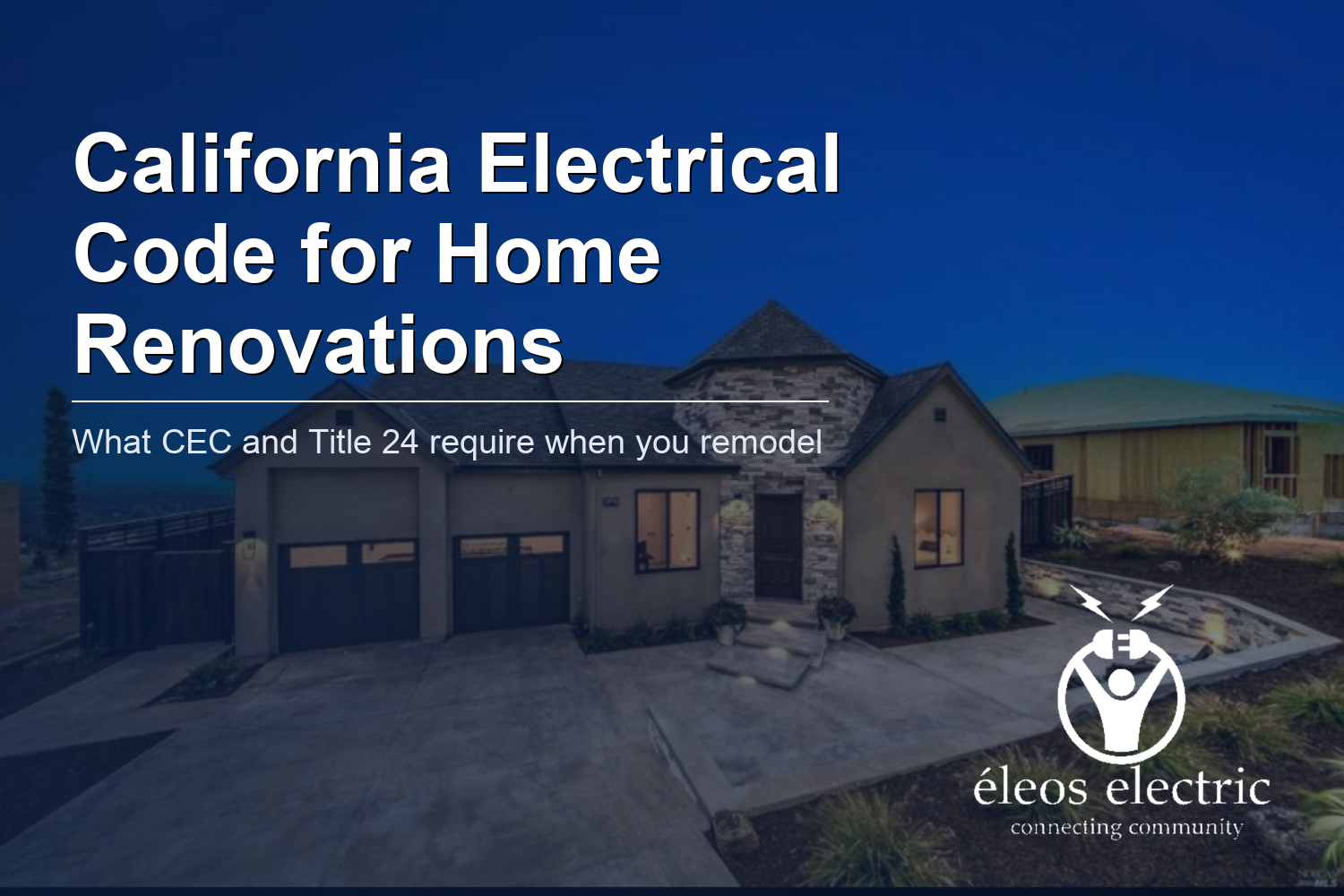
Renovating in California means meeting the California Electrical Code (CEC, based on the NEC) and Title 24 energy standards. Both have tightened a lot in the last decade — what passed inspection in 2010 won't pass in 2026. Here's the short list of requirements that catch most Sonoma County homeowners off-guard.
AFCI and GFCI protection is broader than ever
Every 15A and 20A 120V circuit in living areas now requires AFCI protection. GFCI protection now applies to kitchens, bathrooms, garages, basements, exterior outlets, laundry, and within 6 feet of any sink — including kitchen islands.
Receptacle spacing in habitable rooms
Receptacles must be placed so no point along a wall is more than 6 feet from one. Walls 24 inches or wider need an outlet. Kitchen counter receptacles must be no more than 4 feet apart, with one on every counter section 12 inches or wider.
Tamper-resistant receptacles
All new and replacement receptacles in dwelling units must be tamper-resistant (TR-rated). The little internal shutters protect kids — and TR-stamped receptacles are required at inspection.
EV-ready and solar-ready requirements
Title 24 requires new and substantially-renovated homes to provide either a Level 2 EV-ready outlet (240V/40A) or sufficient panel and conduit capacity to add one later. Many Sonoma County jurisdictions go further with EV-charger and solar-ready mandates at permit time.
Smoke and CO alarm interconnection
Renovations that disturb wall finishes typically require all smoke and CO alarms in the home to be hardwired and interconnected with battery backup. This is one of the most common code-trigger surprises during a kitchen or bath remodel.
Service capacity and load calculations
If your remodel adds significant load (heat pump, induction, EV charger, hot tub), the inspector will want to see a load calculation against your existing service. We run these as part of the quoting process so the panel question is answered before you commit to the remodel.
Permit and inspection process
Almost any wiring change beyond a like-for-like fixture swap requires a permit in Sonoma County. We pull the permit, attend the rough and final inspections, and stamp off any corrections.
Sonoma County · Since 1990
Talk to a licensed electrician about your residential electrical services.
Free estimates, same-day response, and a real person on the phone — usually the owner.