Where you put the charger matters more than which charger you buy. A poorly placed unit means dragging cables across the floor, awkward angles in the garage, or paying later to relocate. Here's the placement framework we walk every Sonoma County homeowner through.
1. Match the placement to your charge port
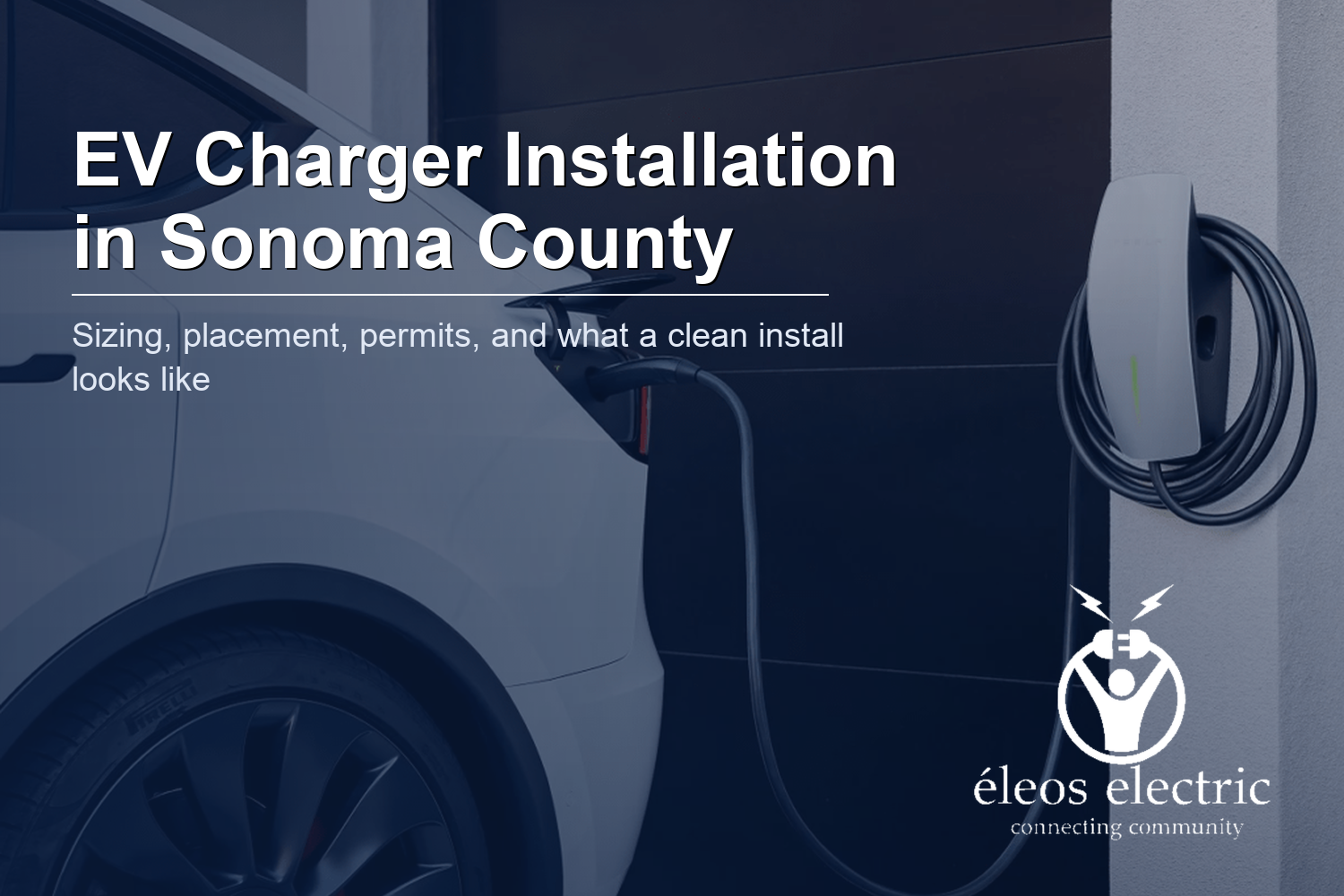
Some EVs charge from the front-left (most Teslas), some front-right (most Chevy and Hyundai), some rear-left, some rear-right. Park as you normally would and stand at the charge port — the charger should be on that wall.
2. Closer to the panel = cheaper
Wire and conduit are the bulk of install cost on long runs. If you can put the charger within 15 feet of the panel and it still hits your charge port, you'll save several hundred dollars.
3. Cable length and management
Most home chargers come with 18–25 ft cables. Get a cable holster on the wall — leaving the cable on the floor wears the connector and is a trip hazard. A 25 ft cable reaches across most two-car garages comfortably.
4. Indoor vs. outdoor mounting
Indoor (garage) installs are simpler and cheaper. Outdoor wall mounts are common when the panel is in a garage and the parking is on a driveway — those installs need NEMA 3R or 4 rated equipment and weather-tight conduit. Both work; just spec the right hardware.
5. Future-proof for two EVs
If there's any chance you'll have a second EV in the next 5 years, pull conduit big enough for two charger circuits now. The marginal cost is small. The cost to come back later and re-trench or re-fish a wall is much larger.
Sonoma County · Since 1990
Talk to a licensed electrician about your EV charger installation.
Free estimates, same-day response, and a real person on the phone — usually the owner.