Sonoma County loses power often enough that everyone has a plan eventually. Here's the playbook we give clients — short outage, long outage, and what to do in the moment when it first happens.
First 60 seconds
Stay calm. Check whether the outage is just you or the neighborhood — look at neighbors' lights or check PG&E's outage map on your phone (which still works on cellular). If only your home is out, check your panel for a tripped main breaker before anything else.
Safety first
Treat downed power lines as live until proven otherwise — stay 35+ feet away and call 911. Don't touch anything connected to a downed line. If you smell gas during an outage, leave the house and call PG&E from outside.
Food and refrigeration
A closed full freezer holds for ~48 hours. A closed full fridge holds for ~4 hours. Don't open them unnecessarily. If the outage stretches past 4 hours, dry ice in the fridge buys you another 24+ hours.
Communication and devices
Cellular networks usually keep running on backup for 4–8 hours. Conserve phone battery — close apps, turn down brightness, switch to low-power mode. A simple battery bank kept charged is the single most useful thing you can buy for outages.
Heat and AC
In summer, close shades and stay on the cool side of the house. In winter, layer up and concentrate everyone in one room. Never run a generator, grill, or camp stove indoors — CO poisoning is a real risk.
After the power comes back
Start with the panel. If anything tripped during the outage, reset it carefully — one breaker at a time, watching for any smells or warmth. Reset clocks. Inspect the contents of your fridge before re-trusting it.
Long-term — prepare before the next one
Sonoma County PSPS events are predictable. Worth doing now:
- Battery backup (Tesla Powerwall, Anker SOLIX, Generac PWRcell) for whole-home or essentials
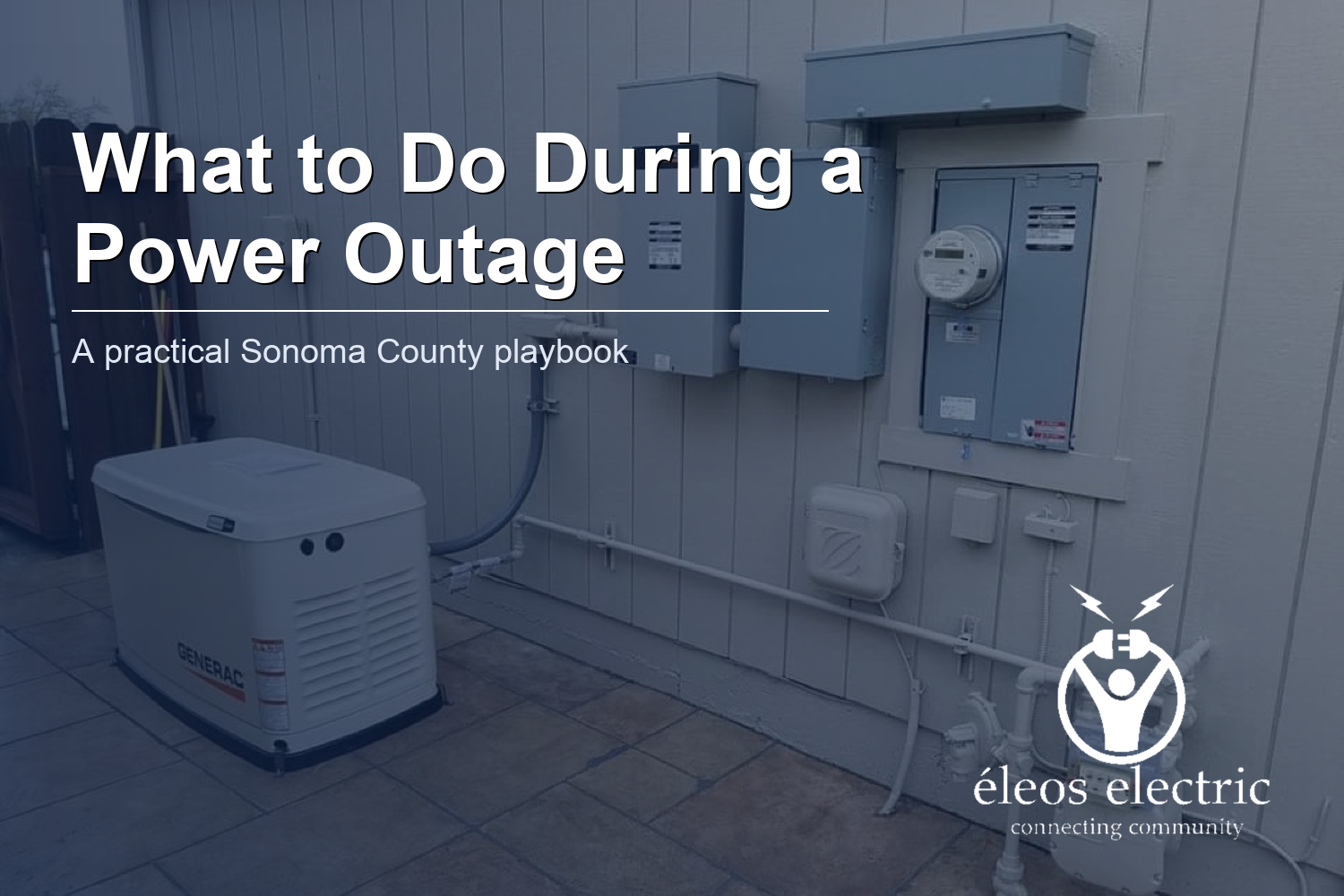
- Standby generator (Generac, Kohler) — automatic transfer when the grid drops
- Portable generator + manual transfer switch — lower cost option, requires you to be home
- Surge protection at the panel — protects against the spike when power comes back
- Phone, headlamp, battery bank, and water stored in a known place
Sonoma County · Since 1990
Talk to a licensed electrician about your backup generator installation.
Free estimates, same-day response, and a real person on the phone — usually the owner.